
When it comes to policies addressing the grid connection of data centers, let’s start with the numbers:
For utilities, this isn't background noise. Decades of interconnection practice rest on one planning assumption: every customer needs maximum firm power at every hour. That assumption is being rewritten in real time, in your state, whether or not your Commission has acted yet.
Enter the Federal Energy Regulatory Commission (FERC), and the opportunity for an (almost) national approach to how these large-loads are going to connect to the grid. FERC's recent action puts a ticking clock on those rewrites.
Six grid operators (excluding ERCOT, who has taken their own action on large-load interconnection recently) have been directed to justify or refile their large-load tariffs within 60 days and report on generation adequacy to serve all these new loads within 30 days.
The five-point reform plan behind that directive addresses the barriers utilities have been navigating one interconnection request at a time: faster studies, real transparency into who bears transmission costs, rules that accommodate co-location and behind-the-meter generation, and new transmission service categories built for loads that can flex.
SPP's tariff structure shows what that looks like operationally. Instead of a single firm-or-nothing offer, large loads choose from a menu: firm service for loads with generation behind it, conditional service for loads willing to accept curtailment while upgrades catch up, and an in-development price-adaptive option for any load willing to shift with real-time conditions.
For a utility, that menu means connecting more load sooner without committing to the full generation and transmission buildout that a purely firm approach would require — and without asking ratepayers to absorb that cost.
For data center developers, the same shift means an actual path to grid power that doesn't depend on waiting out a multi-year transmission queue. Flexibility becomes the term that gets a site connected, not a compromise made after the fact.
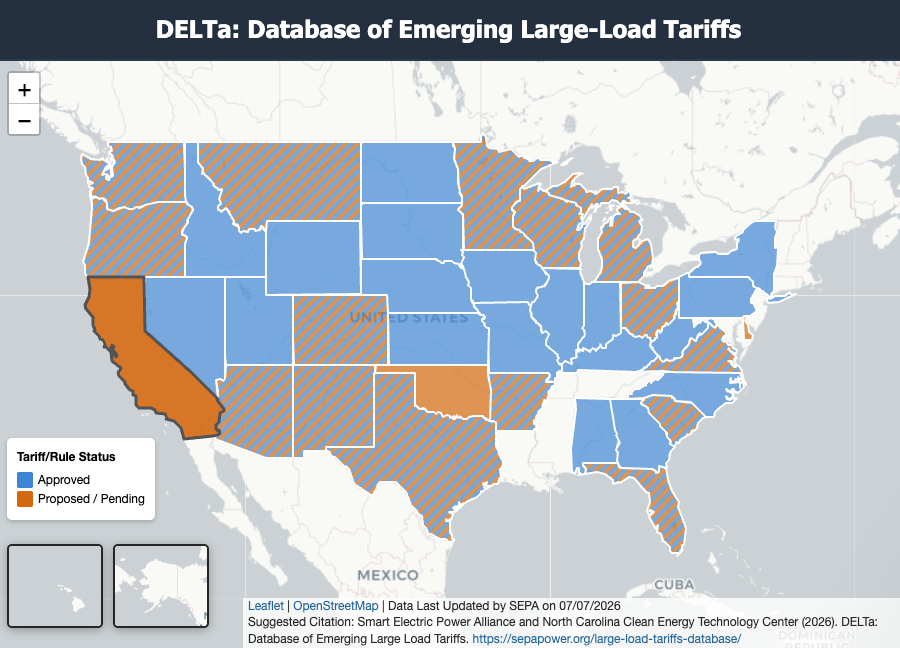
For regulators, the volume of activity (36 states and counting); a set of federal orders; and multiple ISO-level tariff redesigns happening at once — these are the clearest signals available that a new service category is needed, not a patchwork of one-off exceptions.
This is the exact shift Camus has been building for.
We believe flexibility is not a workaround for interconnection delays; it's the mechanism that lets utilities green light new loads sooner, with the opportunity to right-size the buildout for demand that rarely materializes at its theoretical peak.
Three principles guide our approach to flexibility:
The regulatory momentum we're seeing isn't a footnote to this shift. It's evidence that the industry is moving in the same direction. Across 36 state dockets and a federal order, flexibility is increasingly becoming an integral part of connecting large loads to the grid.
See how FlexConnect puts this into practice. →


